
The word “storyteller” means something different to everyone. When I started talking about this part of my life with new friends at work, many jobs ago, I remember them being hung up on the particulars:
“So, like, you write novels? Essays?”
“Ahh, ok, kind of like drag queen story hour? You read books to people?”
“You’re a Ted Talker?”
Technically, they’re all correct when it comes to defining “stories” themselves. Their assumptions around the word “storyteller” are based on the very essence of human connection: the simple and true fact that stories happen. All around us, all the time, hundreds, maybe thousands of times every day.
We read them in short form social media blurbs, we participate in them during the 10-second human interactions we have with our favorite local baristas, we listen to them when our friends tell us about their days. Even this, what you’re reading now, is a story.
It isn’t what I meant, however, when I told them I was a storyteller. At least, not in this specific context.
Storyteller: Performer, entertainer, motivational speaker, blah, blah, blah
“No, sorry, I don’t think I’m being clear at all. Like, I get up on stages and tell stories to people.” I turned 22 shades of red, I think, when I said that out loud. I remember fumbling around for more words to describe what I loved doing. “You know, like, a performer, I guess?”
I can be a somewhat shy person when I’m talking about myself, and so I’m typically overcome by the sensation to escape when I describe how I clamber up on a stage and divulge my real-life experiences to strangers.
“OH, so you’re an actor. Got it. Just say that next time.”
Inwardly exasperated, I sort of shrugged it off and moved the conversation along to a different topic. It IS confusing, especially to someone who’s never been to a show.
However, I certainly wouldn’t consider what I do — and what Salem Story Series is doing — “acting,” for a few key reasons:
- The stories are are all true. In keeping with the spirit of events like these, stories are never manufactured from fiction or fantasy. They can be fantastical, sure, but they need to be real and your own.
- We’re not always memorizing a story. No scripts! In competitions and/or taped recordings, there’s certainly a level of memorization happening, but for the most part, these are spur-of-the-moment thoughts that are ordered together with a few storytelling basics. In fact, memorizing a story is a surefire way to increase anxiety (more on that in a future post).
- There’s absolutely no money in this. Generally, unless it’s volunteer community theater, actors are paid performers. That is almost never the case here. I’ve been paid as a featured storyteller a few times, but this is never the norm (and I’d happily do it for free every time).
- Important note: motivational speakers CAN and often do make a ton of money, and what they do is definitely similar. I’m not one of those, however, so I can’t speak to it with any actual authority. If you’re one, let me know how it works!
So, what IS storytelling, then?
If you ask the internet, you’ll get a lot of answers to “what is storytelling?”, and as I said above, they’re (probably) all true. Storytelling encapsulates a big category of human behaviors.
In this niche world, however, there’s an element of structure, with guidelines and instructions. It’s all of what the broadest descriptions of “storytelling” suggest, but refined for an audience.
At shows like Salem Story Series, of which there are many across the country, there’s often a (very simple and accessible) outline to telling a story on a stage:
- It needs to be true. The best stories come from true life experiences. Because there is a level of performance to this sort of thing, giving the audience a story they’ll remember is as simple as being your real and most authentic self.
- It has to be time-boxed. People can go on and on and on and on. I certainly can. Part of this art form is being able to tell a story within a specific timeframe, which usually means there’s an element of structure and style happening that we’re often not aware of.
- It needs to have the “so what?” factor. The Moth calls it “knowing the stakes,” novelists call it the “conflict,” the French call it the “je ne sais quoi;” it’s the part of your story that needs to be told. It’s what will have your audience leaning in. It’s the driving action behind why you thought to tell the story in the first place.
- It needs to have a clear beginning, middle, and end. While probably a given, it is always where I start when I try to think through a story for the first time. It’s remarkably soothing to intentionally sit down and consider these somewhat obvious goal posts, especially before sharing it out loud.
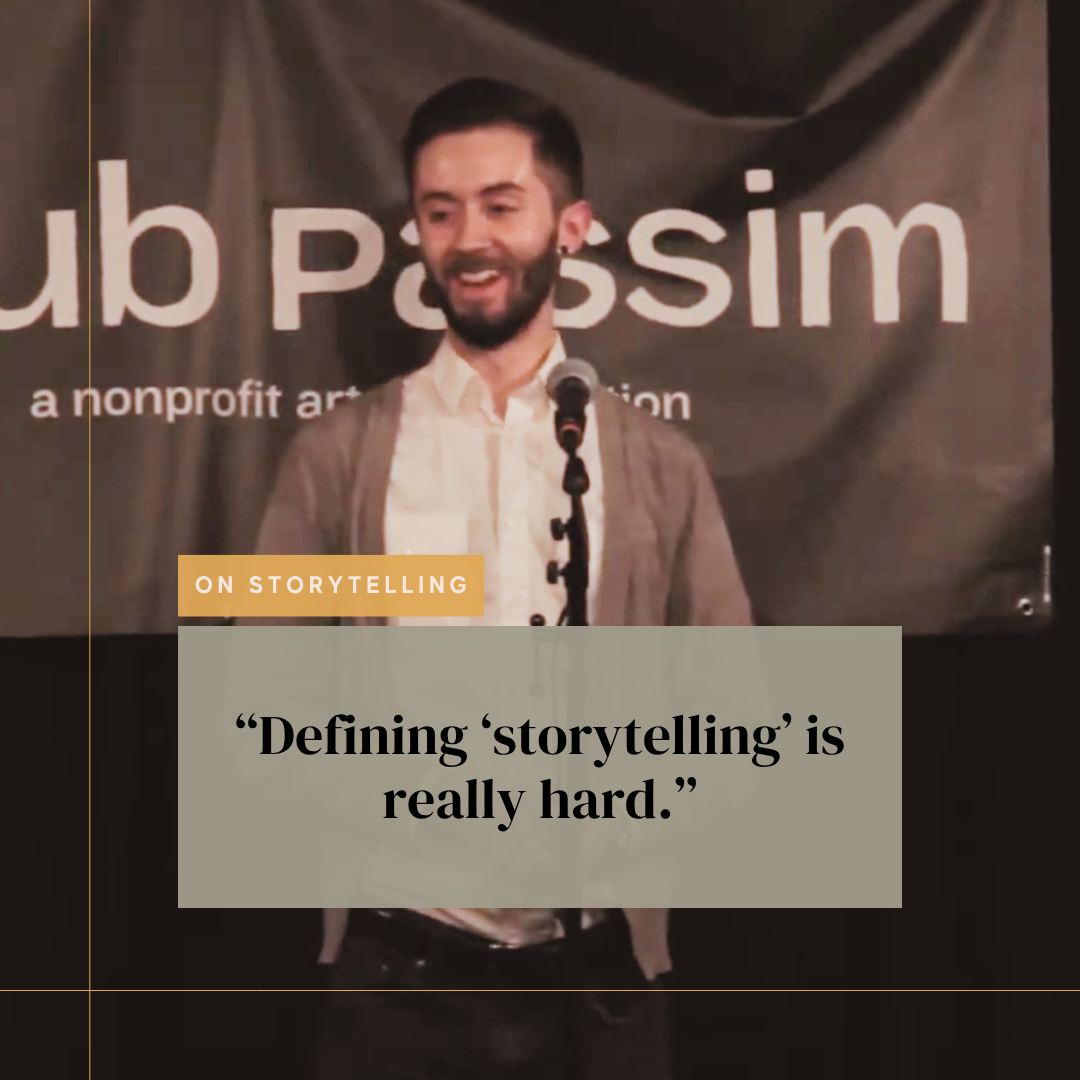
In the example below, the theme was “Shelter.” I was an audience member whose name was called at a MassMouth story slam in Cambridge, at Club Passim. My “so what?” regrettably appears a bit later in the intro than I probably would tell it now, but all of the pertinent elements are present. Showing is easier than telling in most cases:
If I were able to go back in time, I’d hopefully remember that self-promotion isn’t always terrible, and I’d ask that group of people at work to search for my name on YouTube to find this clip. THAT is what I meant by “I’m a storyteller.”
Story thoughts and words of encouragement
After watching that clip again for the first time in a long while, I can tell right away that YES, I was nervous, which accounts for the stumbles I took in the beginning, and YES, I felt some pressure knowing I was entering this story into a competition (context: MassMouth was a competitive version of how Salem Story Series is structured, with judges and tiers, and so on). It’s also important to note that I’m proud of past Shay! It was one of our first stories, and it did OK in the competition.
As another layer of “what is storytelling?”, I’d like to offer the words of encouragement I’d give to past Shay, which are what I’d share with practically everyone gets up on a stage for the first time:
- Your story is important. We never know who we might touch in moments like these. We’ll never know who needs to hear that we’ve experienced something similar to something they’ve experienced. That level of connection between strangers can provide so much peace.
- It’s OK to be nervous. We live in a world that expects us to police every aspect of ourselves in public, especially in situations like these. However, we are mere mortals, and nervousness happens. When it comes up, ride it out.
- Deeply emotional narratives CAN be funny. After I saw this video for the first time, I was feeling a lot of anxiety around the 2:20 mark because of the laughs I was getting. At its core, the story represents hope and healing, but the journey to get there was harrowing, and I was worried I was cheapening it by sprinkling in humor. That’s OK! As long as we’re respectful of the audience and aren’t warping the context to get a laugh at the expense of the story’s integrity, it’s actually a useful way to diffuse tension. AND it keeps the audience’s attention.
- Let your audience hold you. Even now, after something like this, my instinct is to flee. Being “seen” is hard for a lot of us who enjoy this craft, so at 5:13 when you see me scurry away, I felt past Shay’s intense need to get out of the spotlight immediately. But — and this is a suggestion, not a requirement by any stretch — maybe count slowly to 3 before vanishing. It’s good for us to feel things, and in that moment, the audience wanted me to know that they heard me.
- Do not be surprised when people want to chat during intermission. After you tell your story, you will have become the center of someone’s world for 5 whole minutes. They will want to share that with you. Try to let them. This experience can create lifelong connections (Hi, Cheryl and Theresa and Wes and Norah! <3), but it starts by letting people be people, with you.
Is Salem Story Series looking for storytellers?
The answer to that question is “that depends.” Do you understand what I mean when I say “storyteller” now? Because frankly, I don’t think you do until you’ve given it a whirl!
That’s my cheeky way of saying that while Salem Story Series will always have one storyteller who helps break the ice for us, who I’ve tapped in advance of the show as a guaranteed bet, the audience itself is where the storytellers come from.
WE ALL HAVE STORIES WORTH TELLING.
If you’re considering it at all, take that as a sign to try something new. You never know how your story might impact someone else. You never know how telling your story might impact you.
The first Salem Story Series show is on August 25th at 7p, at Gulu-Gulu Cafe in Salem. The theme is “New Beginnings.” Come share your story and then tell me how you describe that experience to other people, because defining “storytelling” is really hard and I need more people to help me figure that part out.
Leave a Reply